AI generated code that’s ready for a bank to run.
AI coding assistants have made software development dramatically faster. Developers used to ask Stack Overflow for answers. Today they ask AI. The difference is that AI answers much faster, even when it is wrong or incomplete. That trade-off is fine when you are building a weekend side project. It is a governance problem when you are building a banking platform.
For regulated industries, speed was never the constraint that mattered most. The real question for any organization evaluating AI adoption is whether the code reaching production can withstand a regulatory audit, a security review and real transaction volumes, without introducing risk that surfaces only after deployment. Generic AI-generated code does not clear that bar by default and the cost of discovering that gap late, in an audit finding or a production incident, is significantly higher than the cost of preventing it upfront.
A regulated institution reducing delivery risk while increasing delivery speed is transformational, most AI tooling typically only delivers the first outcome.
That gap between functional code and production-ready code is where AI adoption in regulated industries typically stalls and where much of the expected return on AI investment quietly erodes. PSL-AIDLC closes it, turning AI-assisted coding into AI-assisted delivery that is secure, compliant and audit-ready from the outset.
Compliance isn’t just a checkpoint.
The industry is entering a new phase of AI adoption. The first wave focused on productivity, while the second one is focused on operationalizing AI across the software delivery lifecycle. As organizations move from experimentation to enterprise adoption, questions around governance, traceability, compliance and accountability are equally important as speed itself.
Generating code using AI is not the real challenge, but whether organizations can trust what AI generates is.
Stop bolting compliance on at the end. Most AI coding workflows generate first and review later, which means every issue gets caught late, after it’s already expensive to fix.
PSL-AIDLC flips that. Audit trails, transaction safety and compliance controls are built directly into generation, then verified again at full review. Nothing depends on a developer remembering to ask for it. Nothing depends on a reviewer catching it by hand under deadline pressure. Regulated organization often live through some version of the same scenario. A system passes every functional test and ships, only for an unlogged failure or a missed compliance control to surface months later as an audit finding or a production incident. They appear once the system is live and by then the cost of remediation, in engineering time, regulatory exposure and customer trust, is substantially higher than the cost of prevention.
The alternative is not slower development. It is ensuring the controls that matter are enforced automatically, at the point code is generated, so the gap between speed and production readiness is closed by design rather than by a review cycle after the fact.
Spec-driven development (SDD) frameworks and other AI tools for SDLC bring real discipline to how AI writes code, breaking work into specs, plans and tasks instead of one long unstructured prompt. But structure that you cannot enforce is just governance. These tools scaffold the workflow, but they don’t verify compliance, run a security review or halt a build over a regulatory control.
PSL-AIDLC is Persistent Systems’ AI-assisted software delivery framework, it layers automated enforcement on top of spec-driven development, so every artifact an AI coding assistant produces is checked for compliance, security and audit-readiness as it is generated, not after the fact. PSL-AIDLC extends beyond AI-assisted coding into AI-Led SDLC, where specialized agents participate across requirements, architecture, development, quality engineering, compliance validation, governance and delivery.
Every agent operates within governed boundaries and contributes to a traceable audit trail. Transaction safety and compliance controls are built directly into generation, then verified again at full review. Nothing depends on a developer remembering to ask for it or on a reviewer catching it by hand under deadline pressure.
Four Layers, One Trust Framework, Zero Blind Spots. Every request your AI coding assistant handles runs through purpose-built checks designed for regulated delivery, end to end.
Reference Architecture
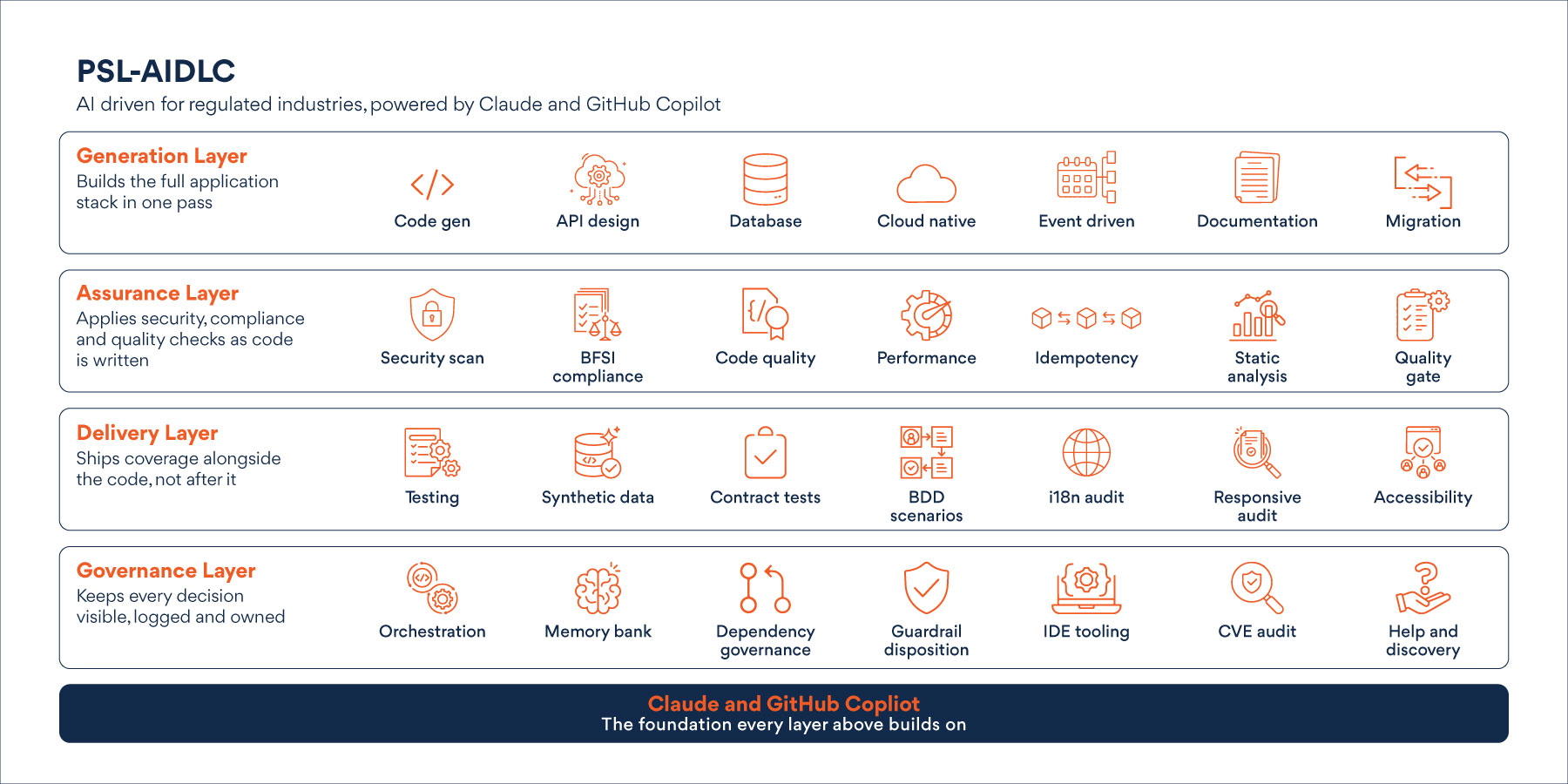
- Generation Layer – Build It Right the First Time
The full application stack, in one pass. Controller, service, domain, repository, event layer, configuration, production-ready from the start. API design, database migrations, cloud native config, event driven wiring and documentation, all handled automatically. What comes out is ready to review, not a rough draft. - Assurance Layer – Nothing Gets Through Unchecked
Industry standard vulnerability classes are identified early and verified again before release. Banking and financial services controls (e.g., PCI-DSS, RBI Guidelines), data integrity, audit trails and transaction safeguards, are applied automatically. Architectural and quality standards, along with a formal quality gate, stand between generated code and production. - Delivery Layer – Coverage That Ships With the Code
Unit, behavioral and contract tests, generated alongside realistic synthetic data. BDD scenarios, internationalization audits, responsive design checks, accessibility review, the same rigor from backend to frontend, without the manual lift. - Governance Layer – Full Accountability, Always
Orchestrated pipelines with built-in dependency governance and project memory. Every compliance or security finding gets a logged decision, fixed, waived or escalated, never ignored. IDE tooling, CVE auditing and a built-in help system keep it accountable as your team scales.
AI can generate code, but it does not naturally retain organisational knowledge. Architectural decisions, domain constraints, compliance policies and design rationale often become fragmented across meetings, documents and chat sessions. The PSL-AIDLC Memory Bankpreserves this critical context as a versioned, reusable asset. Every agent operates from the same trusted source of knowledge, ensuring that architecture standards, BFSI regulations, security policies and project-specific decisions are consistently applied throughout the software delivery lifecycle. The result is greater traceability, reduced rework and significantly more predictable outcomes at enterprise scale.
Author’s Profile

Mihir Shelat
SVP, Persistent Systems

Dinesh Rivankar
Principal Data Scientist, Persistent Systems
The post PSL-AIDLC: AI Powered Software Delivery. Engineered for Regulated Industries. appeared first on Persistent Systems.